
CAPABILITIES
Thymaris turns any standard smartphone into an authentication device. End users and inspectors verify a product’s true origin in seconds — and every scan feeds a live picture of what’s genuine, where, and when.
REAL-TIME DATA

Authentication runs on the standard smartphones already in everyone’s pocket — no scanners, no special training. A scan takes only a few seconds and can be performed in public, which is exactly what makes high-volume authentication realistic. Depending on the deployment, Thymaris offers two modes:
The Thymaris App — For regulated and high-security industries: highest performance, ideal for inspectors working in public-scanning environments.
Public scanning (web app) — For consumer goods at ultra-high volumes: the code is read through a web app and the query is routed to the Thymaris server — with no install for the end user.
MARKET SURVEILLANCE
Because anyone can scan, volume scales into the millions — and that volume is the point. The adage „what you can’t measure, you can’t control“ applies directly to counterfeiting: even when a minute share of items is verified, you gain a live picture of your market. New counterfeit operations are detected the moment they emerge, suspected offenders are identified almost instantly, and the data is handed to law enforcement for rapid action. Traditional optical or physical checks examine only a handful of items by hand — far too little data to identify, let alone prosecute, a meaningful share of counterfeiters.
Thymaris allows to acquire real time data of the supply chain. Because it can combine uniqueness information with originality status of objects it can create a comprehensive status of all assets.
Thymaris is specifically designed to work with off the shelf smartphones without accessories. This allows scanning by everyone.
The patent protected Thymaris technology allows to make validity checks and authentication checks in one scan. This avoids cumbersome processes.
THE COMMAND CENTER

Technology alone isn’t enough — it has to live inside an operational ecosystem that monitors and validates every scan in real time. The Thymaris dashboard is that command center. Like a spider at the center of its web, it orchestrates all critical information: incoming data is triaged and correlated, high-stakes anomalies are flagged for manual inspection, and patterns are clustered to expose the infrastructure behind illicit organizations — the forensic foundation for involving authorities and launching prosecutions
Effectiveness
In 2021, a large‑scale tax‑label system was launched in a Southeast Asian country with THYMARIS supplying the core authentication technology. Billions of labels are produced each year and affixed to a wide variety of products. Because the system relies on public scanning, it generates a five‑digit‑plus volume of authentication checks monthly, enabling rapid detection of counterfeit activities. Suspected offenders are promptly identified and handed over to law‑enforcement for neutralization. Compared with traditional optical or physical authentication methods, this approach delivers a dramatically higher level of effectiveness as follows:
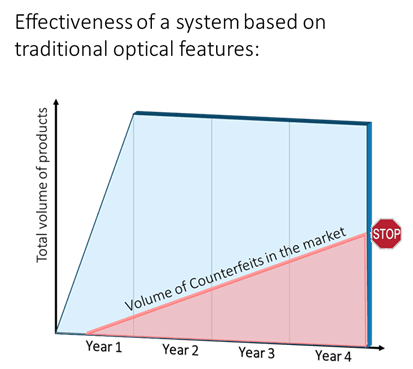
Traditional authentication methods—such as inspecting holograms, security inks, or guilloché patterns—are labor‑intensive and require highly trained specialists. Consequently, only a limited number of items can be examined, producing insufficient data to identify and prosecute a meaningful share of counterfeiters. After a few years, the volume of falsified tax labels becomes so high that the entire system must be replaced.
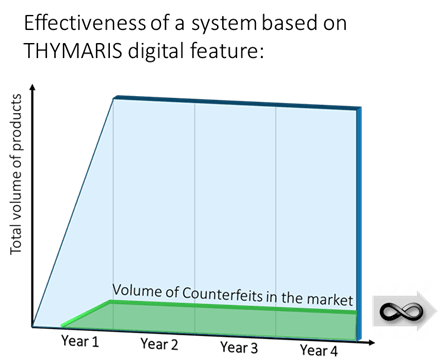
Using smartphones for authentication is both convenient and reliable. The simple act of scanning encourages broad public participation, generating a high volume of scans that underpin effective market surveillance. New counterfeit operations are identified and stopped almost instantly, keeping the overall counterfeiting rate consistently low since the system’s launch.
Get Started
Book a short demo and we’ll show you authentication in action — on your packaging, your codes.
FAQ

How fast is a single scan? A few seconds, on a standard smartphone — no special hardware or training.
Do end consumers need to install an app? No. For consumer goods, public scanning works through a web app. The Thymaris App is for inspectors and regulated/high-security use.
What does the dashboard show? Real-time scan activity, flagged anomalies and clustered patterns that reveal counterfeit networks — usable as a basis for investigation.
Can the data support legal action? Yes. Findings provide the forensic basis to involve authorities and launch prosecutions.
How much scanning is „enough“ to be effective? Even if a minute share of items is scanned it gives reliable market surveillance. This is very realistic, because smartphone scanning is free and public.